
How the Houthis Changed Modern Economic Warfare

Key takeaways
Houthi attacks in the Bab el-Mandeb Strait have demonstrated how relatively low-cost drone and missile attacks can generate disproportionate economic disruption across global supply chains, shipping lines, and energy markets.
More than 60% of shipping was rerouted around the Cape of Good Hope following Houthi attacks in late 2023, driving major increases in insurance premiums, freight rates, transit times, and fuel costs for global trade operators.
Despite the October 2025 ceasefire and an apparent end to Houthi attacks in the Red Sea, maritime risk perceptions remain elevated, with a significant proportion of container traffic continuing to avoid the region due to persistent security concerns.
Any renewed Houthi attacks in the Red Sea would likely compound existing instability surrounding the Strait of Hormuz, increasing the risk of further disruption to global energy supplies, shipping routes, and logistics costs.
The campaign highlights a broader shift in modern economic warfare, where non-state actors can exploit maritime chokepoints to create market uncertainty and impose significant costs on global businesses without matching the conventional military capabilities of major powers.
Who are the Houthis?
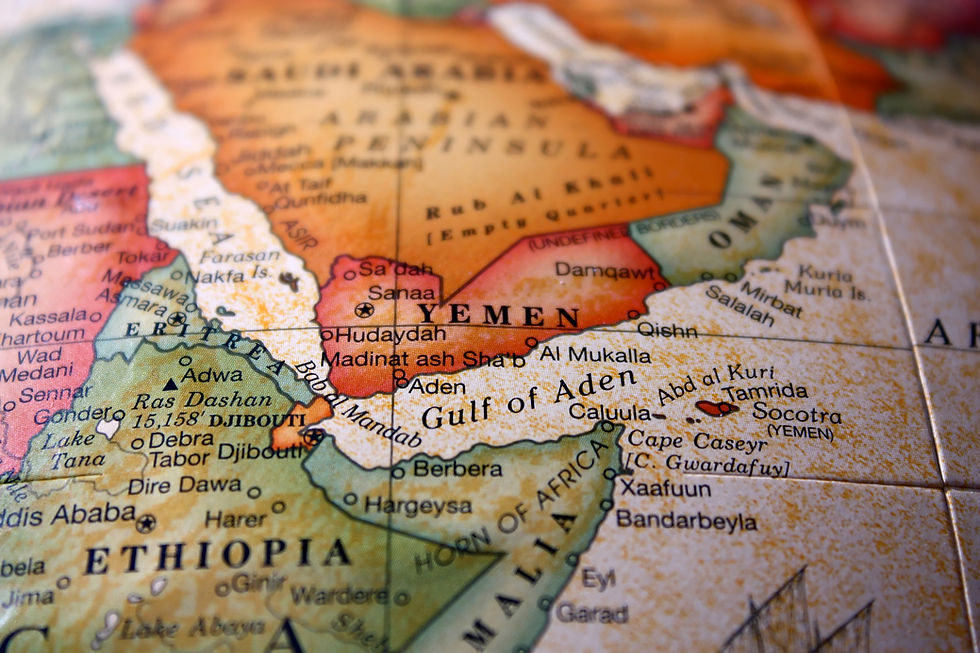
The Houthis, formally known as Ansar Allah, emerged in northwestern Yemen during the 1980s as a Zaydi revivalist movement opposed to corruption and foreign influence. Following the instability of the Arab Spring uprisings, the group expanded rapidly, capturing the capital Sana’a in 2014 and evolving from a domestic insurgency into a regional actor. Their control over parts of Yemen’s Red Sea coastline later gave them influence over one of the world’s most strategically important trade corridors, the Bab el-Mandeb Strait. Acting at the only entry point to the Red Sea from the Indian Ocean, the Bab el-Mandeb Strait is a critical channel for energy supplies travelling between Asia and Europe.
Asymmetric warfare in the Red Sea
Beginning in late 2023, the Houthis launched attacks on commercial shipping in the Bab el-Mandeb Strait in response to the Israel-Gaza conflict. The significance of these attacks stemmed largely from geography as this narrow corridor accounts for roughly 10% of global trade and 12% of global oil transport. The attacks triggered one of the most significant disruptions to maritime trade in recent years. According to the International Monetary Fund, more than 60% of shipping was rerouted around the Cape of Good Hope on the tip of South Africa as companies sought to avoid the Red Sea. Insurance premiums rose from approx. 0.05% to more than 1% of a vessel’s value, potentially adding up to US$1 million per voyage for large tankers.
The Houthis achieved such immense economic disruption without conventional naval power. Relatively cheap drones and missiles were directed against commercial vessels, exposing an asymmetry between the low cost of attack and the far greater cost of defence and mitigation. The Houthis demonstrated how non-state actors can impose a significant economic toll on global trade with defence systems designed to counter conventional state threats rather than dispersed non-state actors using cheap drones and missiles.
Consequently, it was soon realised that the Houthis do not need to destroy global shipping to generate an economic impact. The Houthis need only generate uncertainty to make the Red Sea appear unpredictable for insurers and shipping firms to reassess the risk landscape. The economic consequences were far greater than the physical damage inflicted, as the perception of risk alone was enough to force companies to reroute vessels and reassess costs as insurance premiums rose dramatically.
October 2025 ceasefire
Houthi maritime attacks ceased in October 2025 following the Israel-Gaza ceasefire and some shipping traffic gradually returned to the Red Sea. However, roughly 70% of rerouted container traffic continued to travel around the Cape of Good Hope despite the reduction in attacks. Insurers and shipping firms maintain elevated risk calculations in the Red Sea, highlighting how each new crisis raises the perception of cost and risk permanently. The Houthis permanently altered perceptions of maritime risk in the Red Sea. Even without sustained attacks, instability remains embedded in the risk calculations of global shipping.
Renewed threats
Current tensions surrounding the Strait of Hormuz have renewed concerns over the Houthis revitalising their attacks in the Red Sea, as this would compound the already devastating economic consequences of the US-Iran War. Houthi leader Abdul Malik Al Houthi warned of potential escalation in April 2026 if the United States (US) continues to escalate attacks on Iran. While the Houthis have not yet resumed attacks in the Strait of Bab el-Mandeb, Iranian officials have continued threatening disruption. With the blockade of the Strait of Hormuz already placing intense pressure on global energy markets, renewed attacks in the Red Sea could further disrupt trade routes, raising shipping costs and fuel prices even further.
The limits of escalation
Despite increasingly aggressive rhetoric, a renewed anti-shipping campaign is not inevitable. The Houthis remain under economic and military pressure following extensive US and Israeli strikes in 2025. An analysis from US Congress notes how renewed attacks would be more consequential than in previous years and risk further international retaliation at a time when the Houthis are rebuilding from significant infrastructure losses, facing growing economic strain, and potentially receiving more limited support from Iran amid wider regional pressures. With these factors, the Houthis must consider how much of its diminishing military stockpile it can afford to use.
The Houthis, and likely Iran, no longer view Red Sea disruption as a day-to-day tactical routine to inflict an economic toll, but as a deterrent of last resort which carries significant retaliatory risks. Therefore, the absence of attacks does not necessarily reflect a loss of capability, but a strategic decision. Renewed attacks in the Bab el-Mandeb Strait is a Houthi option and if hostilities against Iran escalate, may well be utilised. As recently as 18 May 2026, Abdul-Malik al-Houthi warned that further escalation would have “serious consequences”.
The Houthis fundamentally changed modern economic warfare. The non-state actor has demonstrated that even a small group can impose asymmetric costs on multiple major global powers. By exploiting the geography of global trade and the low-cost methods of warfare utilising drones, the Houthis have reshaped global trade patterns by weaponising the psychology of risk. Even several months since their last maritime attack, the Houthis continue to deter maritime shipping returning to the Strait of Bab el-Mandeb. Uncertainty itself has become a tool of economic pressure, and the strait a weapon of last resort.
Business Implications
The Houthi campaign highlights how geopolitical instability around critical trade corridors can rapidly translate into higher operating costs for global businesses. Even limited attacks were enough to increase insurance premiums and extend transit times, disrupting energy markets and forcing large-scale rerouting around the Cape of Good Hope. The Red Sea crisis demonstrates the growing importance of supply chain diversification.


