
Italy: Authorities Launch Investigation into Sabotage Incidents Targeting Winter Olympics

Sabotage Incidents
On 07 January 2026, rail infrastructure was targeted by saboteurs, causing significant disruption to train services on the opening day of the Winter Olympic Games. Three distinct incidents were reported in Bologna, and another in Pesaro. Electrical cables used to detect train speeds were found severed in Bologna, while a rudimentary improvised explosive device (IED) was discovered by a track at a nearby location. Additionally, a cabin housing a track switch was set on fire near the Adriatic city of Pesaro. Bologna is a major junction for Italy’s east-to-west rail lines that supports those travelling to Milan, the co-host of the Winter Olympics, and Cortina, the other co-host which is reachable via train and bus from Venice. The state-owned railway, Ferrovie dello Stato, was forced to temporarily close its high-speed station in Bologna as a result. Rail services slowly returned to normal by the afternoon. Deputy Prime Minister and Transport Minister Matteo Salvini has pointed out that the attacks mirrored those affecting France's high-speed TGV network on the opening day of the 2024 Summer Olympic Games in Paris.

Map showing the two incidents in Bologna
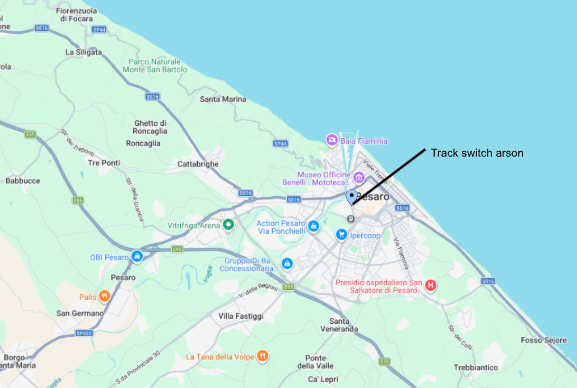
Map showing the incident in Pesaro
Demonstrations
On the same day as the sabotage incidents, an anti-Olympics demonstration broke out in Milan. An estimated 10,000 people gathered to protest against housing costs and environmental concerns linked to the Winter Olympics. A group of roughly 100 protesters broke away from a larger demonstration, throwing firecrackers, smoke bombs, and bottles at the police, who deployed water cannons and detained six individuals. Italian Prime Minister Giorgia Meloni labelled the demonstrators “enemies of Italy”. The demonstration was not the first to be staged over the Winter Olympics. On 31 January 2026, hundreds of demonstrators staged a rally in Milan over the deployment of Immigration and Customs Enforcement (ICE) agents at the Games. On the same day, 100 police officers were injured and nearly 30 protesters were arrested at a demonstration in Turin, similarly taking issue with reports regarding ICE. Some groups have also argued that the Olympics are a waste of public money and resources.
Suspicion falls on Moscow
Nobody has claimed responsibility for the sabotage incidents. However, many will unsurprisingly be looking at Moscow with suspicion. On 05 February 2026, Italian Foreign Minister Antonio Tajani announced that a Russian cyber-attack targeting the Winter Olympics had been foiled. According to Tajani, websites linked to the Games, hotels in host town Cortina, and foreign ministry facilities, including an embassy in Washington, were targeted. Russia has intensified its grey zone operations across Europe in an effort to punish Ukraine’s allies for their support for Kyiv. Russia has also been banned from participating in the Olympics over the conflict, with some Russian athletes instead participating as neutrals. Targeting the Winter Olympics represents a particularly symbolic means of making a political statement. However, with police investigations ongoing, it is important not to draw any conclusions.


