
Gold, Shipping and Sovereignty: Why Canada’s Hope Bay Mine Matters

Key takeaways
Agnico Eagle’s decision to invest US$2.4 billion in the Hope Bay gold project in Nunavut demonstrates how Arctic resource development is becoming increasingly commercially viable and strategically important for Canada.
The project’s reliance on seasonal barge shipping through the Northwest Passage highlights the growing role of maritime access in reducing the cost of operating in Canada’s remote northern regions.
Hope Bay is expected to produce more than 400,000 ounces of gold annually, support close to 2,000 jobs and increase Canadian exports by C$2.6 billion each year.
Canada increasingly views Arctic infrastructure, mineral development, clean energy and defence capability as connected elements of national sovereignty and economic resilience.
For businesses, the Arctic is no longer solely an environmental or security issue. It is emerging as a supply-chain frontier where mining, shipping, infrastructure, Indigenous partnership and geopolitical competition intersect.
A gold mine with wider significance
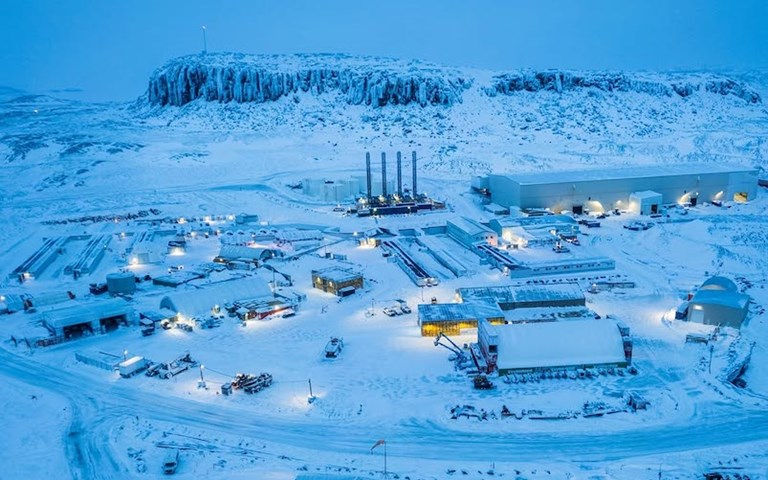
Canada’s Arctic has long been defined by distance, high operating costs and a lack of infrastructure. However, Agnico Eagle’s decision to revive the Hope Bay gold project in Nunavut shows how this calculation is beginning to change.
On 19 May 2026, the Canadian mining company approved a US$2.4 billion investment in Hope Bay, located in Canada’s northernmost territory. The project is expected to produce between 400,000 and 435,000 ounces of gold annually, with an initial mine life of 11 years and potential for further expansion through continued exploration.
Hope Bay is commercially significant because it seeks to overcome the central obstacle facing Arctic mining: cost. Remote northern projects must transport machinery, fuel, construction materials and supplies across vast distances, frequently without the road, rail or port infrastructure available in southern Canada.
Agnico Eagle believes it can keep production costs below US$1,000 per ounce partly through increased use of barge transport during the summer shipping window. This makes Hope Bay more than a mining project. It is also a test of whether Arctic maritime logistics can support increasingly large commercial investments in Canada’s north.
The Northwest Passage as an economic corridor
For much of Canada’s history, the Northwest Passage has been viewed primarily through the lenses of exploration, sovereignty and defence. It is now increasingly relevant to business. The route remains challenging. Sea ice, harsh weather, limited emergency response capacity and seasonal access all constrain commercial activity. Companies operating in the Arctic have traditionally depended heavily on air transport or ice roads, both of which can add considerable cost and vulnerability to supply chains.
However, environmental change is altering the operating landscape. Longer periods of navigable water are making summer barge movements more practical for destination shipping: transporting equipment and supplies into Arctic communities and industrial sites rather than using the passage as a fully developed global transit route.
Hope Bay illustrates this shift. If heavy equipment, fuel and construction material can be delivered more economically by sea, projects previously considered too expensive may become commercially viable. This could generate wider demand for ports, marine services, ice-capable vessels, fuel storage, communications, search-and-rescue infrastructure and environmental monitoring. The strategic consequence is clear: maritime access in the Arctic is becoming an enabler of economic activity. For Canada, commercial use of northern waterways is also a way of strengthening physical presence in a region where presence itself has sovereignty value.
Resources, sovereignty and security
The Canadian government has been explicit about the national significance of Hope Bay. Natural Resources Canada described the project as one of strategic importance, projecting that it will increase Canadian exports by C$2.6 billion annually and support close to 2,000 jobs, including economic opportunities involving Indigenous organisations and partners such as the Kitikmeot Inuit Association.
Gold is not a critical mineral in the same manner as lithium, cobalt, nickel or rare earth elements. Nevertheless, the infrastructure and operating knowledge created around a large Arctic mine can help unlock a wider northern resource economy. Roads, energy systems, ports, shipping services and skilled workforces established for one project may eventually support others.
This matters at a time when Canada is placing greater emphasis on reducing strategic dependencies. Its Arctic Foreign Policy identifies the north as a potential source of minerals essential to energy transition and allied supply-chain diversification. It also highlights growing interest from non-Arctic states, including China, in Arctic shipping and resource development.
In March 2026, Prime Minister Mark Carney announced more than C$35 billion in federal investments intended to defend, build and transform Canada’s Arctic and northern region. The plan directly connected critical minerals, clean energy, trade corridors and Arctic sovereignty.
Hope Bay therefore sits within a much larger policy shift. Canada is no longer treating northern resource development, defence infrastructure and shipping access as separate issues. They are increasingly viewed as mutually reinforcing parts of national resilience.
The local dimension
Arctic development cannot be measured only through export value or geopolitical advantage. Northern communities have frequently faced inadequate transport, high energy costs and limited access to economic opportunities while major decisions about the Arctic have been made far from the region itself.
For Hope Bay to represent sustainable northern development, the benefits must be visible locally. The federal government has announced C$25 million for the Hope Bay Wind Project, led by Inuit-owned and operated Kitikmeot Tugliq Limited Partnership. The initiative is expected to add wind and battery capacity to the mine’s power system, reducing diesel consumption by approximately three million litres annually.
This is important for business risk as well as social responsibility. Arctic projects require durable relationships with local and Indigenous partners. Companies that fail to integrate community participation, environmental safeguards and local economic benefit may face delays, legal challenges and reputational harm in an increasingly scrutinised region.
A changing Arctic risk landscape
The opening of new commercial possibilities in the Arctic does not remove risk. It creates new forms of it. Warmer conditions may make shipping more accessible during parts of the year, but they also contribute to unstable ice, coastal erosion, permafrost thaw and increased environmental sensitivity.
Commercial operators will need to understand that Arctic logistics cannot be managed in the same way as established trade corridors. A delayed barge shipment, marine incident, fuel spill or infrastructure failure may have consequences in locations where response capacity is limited and replacement supplies cannot arrive quickly.
Geopolitical risk is also increasing. As northern routes and resources become more economically attractive, Canada will face stronger pressure to demonstrate control, surveillance, infrastructure capacity and meaningful partnership with Arctic communities.
Business Implications
The Hope Bay project shows that Canada’s Arctic is beginning to move from strategic concept to commercial supply chain. For mining companies, the north may offer increasingly viable resource opportunities, supported by maritime access and government investment. For shipping, logistics, energy and infrastructure firms, Arctic development could create demand for specialised vessels, seasonal freight planning, renewable-energy systems and remote operating capability.
However, the opportunity comes with complex environmental, operational and geopolitical risks. Businesses entering the Arctic will need more than an investment case. They will require resilient logistics, strong Indigenous partnerships, credible environmental planning and a clear understanding of Canada’s sovereignty and security priorities.
Hope Bay is not simply a gold mine returning to production. It is an early indicator of a broader shift: Canada is beginning to use economic infrastructure to reinforce its position in the Arctic, and the Arctic itself is becoming an increasingly important frontier for global business.


